Bulk Mulch Vs Bagged
3–6 Cubic Yards: When Bulk Mulch Beats Bagged for Homeowners
For a small bed or a quick color refresh, bagged mulch wins on convenience. Once you’re covering more than roughly 3 to 6 cubic yards, bulk almost always saves money and gives you fresher, more varied material. The trade-offs that don’t show up on a receipt, like driveway staining, plastic disposal, and spreading time, often matter as much as price, and that’s where a professional delivery and installation service can earn its cost back.
TL;DR:
- Bulk mulch generally becomes more cost-effective than bagged mulch when ordering more than three to six cubic yards, especially with lower delivery fees.
- During spring sales, bagged mulch can drop to as low as $2 per bag, making it cheaper than bulk for any project size.
- Accurate coverage calculation requires multiplying bed area by depth, then dividing by 27, with extra volume recommended for irregularly shaped beds.
- Bagged mulch suits small jobs under one cubic yard and situations with limited staging space, while bulk is better for larger projects.
- Hiring professional delivery and installation saves time, reduces driveway staining risks, and ensures correct spreading, especially for jobs over several cubic yards.
Table of Contents
- Bulk Mulch vs Bagged Cost: Worked Breakeven Examples
- How to Calculate Mulch Coverage by the Yard or Bag
- Bagged Mulch: When Convenience Beats the Price Tag
- Bulk Mulch: Why Bigger Jobs Favor Buying by the Yard
- Delivery Logistics, Staining, and Environmental Trade-Offs
- Decision Checklist: Bags or Bulk for Your Project
- What Roberto Sees on Job Sites Across North Atlanta
- Does Mulch Type Affect Plant Health and Weeds
- What Mulch Types Come in Bulk vs Bags
- Keeping Mulch Fresh Before You Spread It
- Let Roberto Handle Your Mulch Delivery and Installation
- The Real Decision Isn’t Price, It’s What You’re Willing to Handle
- Sources
- FAQ
Bulk Mulch vs Bagged Cost: Worked Breakeven Examples
The math starts with a simple conversion. A standard bag holds 2 cubic feet, and it takes about 13 to 14 bags to equal one cubic yard. Bagged mulch typically runs $4 to $6 per bag at retail, while bulk mulch delivered runs $35 to $65 per cubic yard, plus a delivery fee that commonly falls between $50 and $150 depending on distance and order minimums.
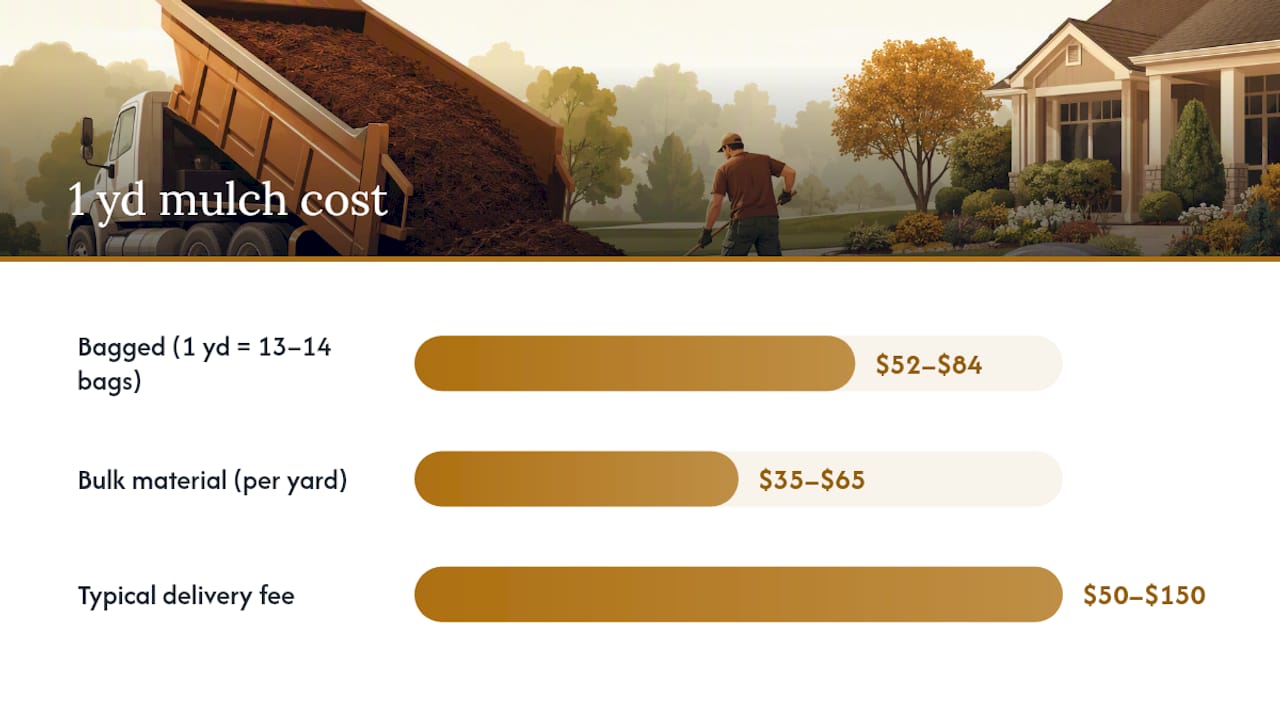
Run the numbers at regular prices and bags stay cheaper up to a moderate volume range, based on sample price points with per-bag and bulk yard plus delivery charges. Cross that threshold and bulk pulls ahead fast, since you’re no longer paying for plastic packaging or per-unit retail markup.
Three scenarios show how this plays out:
- Small bed refresh (1 cubic yard): About 14 bags at $5 each runs roughly $70, with no delivery fee if you haul it yourself. Bulk at this size rarely beats bags once you add a delivery charge for such a small load.
- Mid-size landscaping job (4 cubic yards): Bags cost around $280. Bulk at $45 per yard plus a $75 delivery fee lands near $255, a modest but real savings, and the gap widens if your local yard charges less per yard.
- Large property or commercial job (multiple cubic yards): Bulk mulch can be noticeably less expensive than bagged mulch as the project size increases.
Here’s the catch that trips people up: big-box spring sale pricing can drop bags to $2 each during peak planting season. At that price, bags beat bulk at almost any size, so timing your purchase around a sale changes the entire equation.
How to Calculate Mulch Coverage by the Yard or Bag
Coverage math is one formula, repeated. Multiply the square footage of your bed by the depth in inches, divide by 12 to convert to feet, then divide by 27 (the number of cubic feet in a cubic yard) to get the cubic yards you need.
A 200 square foot bed at 3 inches deep needs about 1.85 cubic yards. That same bed at 2 inches needs roughly 1.2 cubic yards, which is the gap that matters when you’re deciding whether to round up to bulk or stick with bags.
- 1 cubic yard covers about 162 square feet at 2 inches deep, or 108 square feet at 3 inches.
- A single 2 cubic foot bag covers about 8 square feet at a 3 inch depth.
- Always round bag counts up, never down. A leftover bag is cheaper than a second trip to the store.
- Add 5 to 10 percent extra volume when ordering bulk for irregular or curved beds, since waste and uneven spreading eat into your estimate.
- Check your existing mulch depth first. If last year’s layer is still 1.5 inches thick, you may only need to top off 1 more inch, not start from zero.
Bagged Mulch: When Convenience Beats the Price Tag
Bagged mulch earns its place for jobs where flexibility matters more than cost per yard.
- Best suited for small beds, container gardens, or any job under about 1 cubic yard.
- The clear winner when your driveway, gate, or side yard can’t fit a delivery truck or a loose pile.
- Ideal when you want a specific brand, dyed color, or specialty blend that a local bulk yard doesn’t stock.
- Compare cost by volume, not by the bag. A $5 bag sounds cheap until you realize you need 40 of them for a 3 yard job, which works out to a higher per-yard rate than most bulk delivery.
- Factor in the labor of tearing open dozens of bags and hauling the empty plastic to the curb. Disposal is a real cost, even if it’s not on the receipt.
Bulk Mulch: Why Bigger Jobs Favor Buying by the Yard
Bulk starts paying off once your project crosses a few cubic yards, and the savings compound from there.
- Per-yard pricing drops sharply as volume increases, and you skip the packaging markup built into every bag.
- Bulk material tends to be coarser and less screened than bagged product, which many landscapers actually prefer for weed suppression and moisture retention.
- Landscape yards typically carry more variety, fresher stock, and options bagged retailers don’t offer, like double-shredded hardwood or aged compost blends.
- Expect a driveway dump unless your supplier offers placement options, which means wheelbarrow and shovel labor to move it to the bed.
- Most suppliers set delivery minimums, often 2 to 3 cubic yards, and you’ll need to schedule around their route, not your own timeline.
Delivery Logistics, Staining, and Environmental Trade-Offs
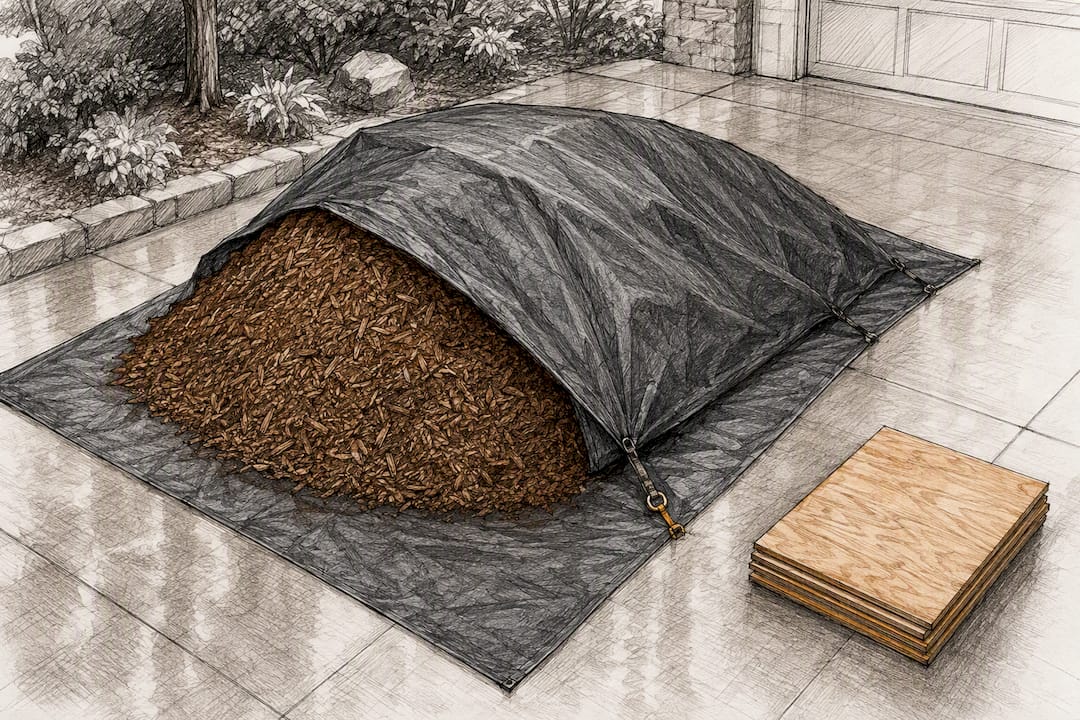
A loose pile of wet bulk mulch sitting on your driveway for a few days can leave a stain that’s tough to scrub out. Spreading it within 24 to 48 hours, or laying down plywood or a tarp under the pile, prevents most of the damage.
Plastic waste is the flip side of the bagged convenience. Forty empty bags from a mid-size job add up fast, while a loose bulk delivery produces none. Some suppliers now offer a 1 cubic yard FIBC bulk bag, a reusable tote that gets craned or forklifted right where you want it, giving you bulk pricing without a pile parked on your concrete.
Time is the trade-off people underestimate. Spreading loose bulk with a wheelbarrow usually takes less total labor than hauling, cutting open, and dumping 40 individual bags, especially once two or more people are working the job.
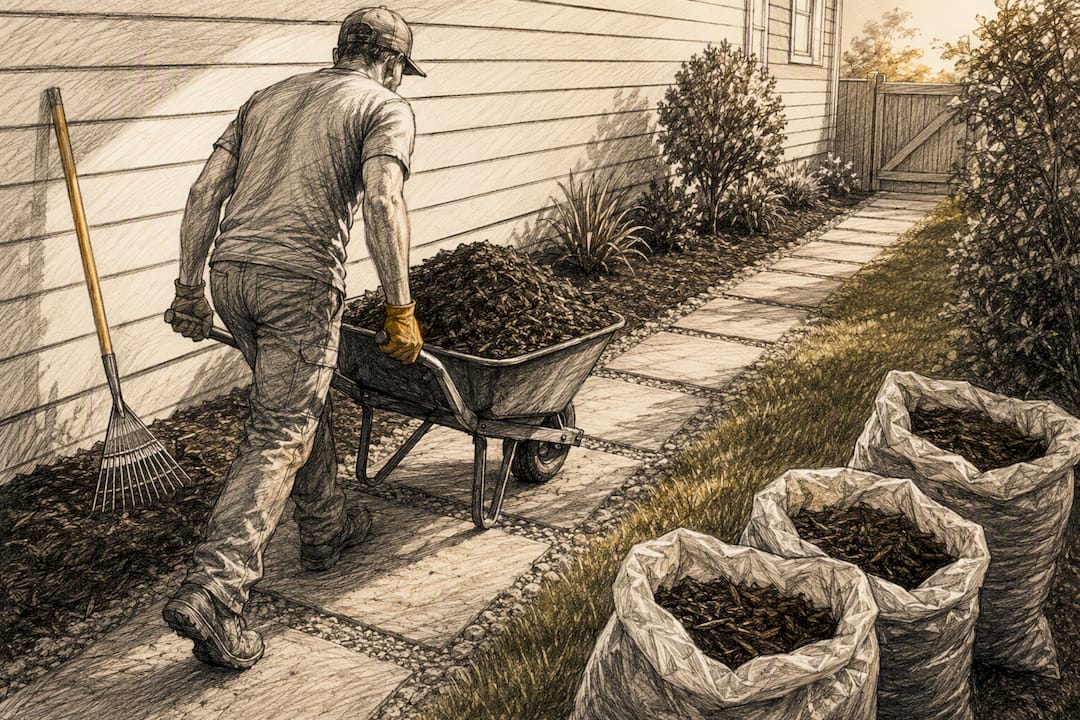
Pro Tip: If you’re ordering bulk and can’t spread it the same day, tarp the pile before rain hits. Wet mulch is heavier, harder to move, and more likely to leave a stain on pavement.
Decision Checklist: Bags or Bulk for Your Project
Answer these questions before you buy, and the right format usually becomes obvious.
- How many cubic yards do you actually need? Use the area times depth formula from the coverage section above, not a guess.
- Do you have driveway or staging space for a loose pile? No space usually means bags or an FIBC bulk bag.
- Can a delivery truck reach your property? Tight alleys, steep driveways, or gated access can rule out bulk entirely.
- What’s your timeline? Bulk needs scheduling around a supplier’s route; bags you can grab today.
- Is a sale running? Spring sale pricing on bags can flip the math even for mid-size jobs.
- Are you willing to handle bag disposal, or would you rather skip it?
As a rule of thumb: under 1 cubic yard, buy bags. Between 1 and 3 yards, run the math, and consider splitting a bulk order with a neighbor. At 3 to 6 yards and up, bulk usually wins at regular prices, though a good bag sale can close the gap. When you call a supplier or contractor, ask for the exact cubic yards delivered, the delivery fee, any minimum order, whether they’ll place it instead of dumping it curbside, and whether FIBC bulk bags are available.
What Roberto Sees on Job Sites Across North Atlanta
Every quote starts with a walk of the property, and that’s not a formality. Seeing the actual bed shapes, driveway access, and slope before ordering material is the difference between a delivery that lands exactly where it’s needed and one that turns into a wheelbarrow marathon.
A few habits from the field: always order a small overage for beds with curves or tree rings, since square footage estimates run short more often than they run long. Schedule bulk delivery for a dry stretch whenever the forecast allows. And when driveway cleanup is a concern, an FIBC bulk bag placed by crane beats a loose pile every time.
A local company in North Atlanta covers many cities, offers free on-site quotes within 1 to 2 days, backs jobs with a satisfaction guarantee, and maintains a high rating on Google.
Does Mulch Type Affect Plant Health and Weeds
Material choice matters more than format. A well-chosen mulch, whether bagged or bulk, suppresses weeds by blocking sunlight and holds soil moisture that roots depend on through summer heat.
Bulk mulch tends to be coarser and less processed than bagged product, and that texture actually helps. Coarser chips break down slower, which means the weed barrier and moisture retention last longer between refreshes. Fine, heavily dyed bagged mulch looks tidy out of the bag but can compact into a crust that sheds water instead of absorbing it.
Depth matters just as much as material. Piling mulch more than 4 inches deep invites a problem called “volcano mulching,” where excess material against a trunk traps moisture and invites rot and pests. The extension guidance is clear: 2 inches for refreshing an existing bed, 3 inches for a brand new one, and never above 4.
Freshness plays a role too. Bulk mulch sold at a busy landscape yard often moves through inventory faster than bagged product sitting on a store shelf for months. Fresher material hasn’t broken down as much, so it holds its structure and weed-blocking ability longer once it’s down. Dyed bagged mulch that’s been stored outdoors through a hot summer can lose color and start decomposing before you even open the bag.
What Mulch Types Come in Bulk vs Bags
Bagged aisles are built around consistency. You’ll typically find dyed hardwood in red, brown, and black, natural cedar or cypress, rubber mulch, and pine bark nuggets in a few standard sizes, all packaged for a predictable look on a small scale.
Bulk yards carry a wider range. Double-shredded hardwood, playground-grade wood chips, pine straw, aged compost blends, and sometimes locally sourced arborist chips show up in bulk that rarely make it into bags at all. If you want a specific dyed color to match an existing bed, bagged is usually the safer bet, since bulk yards don’t always stock every dye shade consistently.
Pine straw deserves its own mention. It’s sold almost exclusively as bales rather than bags or bulk yardage, and it behaves differently in coverage math since it’s measured by bale, not cubic feet. If your project mixes pine straw beds with hardwood mulch beds, keep the calculations separate.
One more distinction: bulk mulch is often a byproduct of local tree removal and recycling operations, which means the blend can vary slightly between deliveries. Bagged mulch goes through more uniform processing, so if visual consistency across a large commercial property is the priority, bagged or a single large bulk order poured at once will look more even than several smaller bulk deliveries from different batches.
Keeping Mulch Fresh Before You Spread It
Bagged mulch stores reasonably well if it stays sealed and out of direct sun. Heat and UV exposure inside a closed plastic bag can actually cook the material, encouraging mold or a sour smell if bags sit stacked in a hot garage for weeks. Keep unopened bags in a shaded, ventilated spot and use them within a season for the best color and texture.
Bulk mulch has the opposite problem: it’s alive with microbial activity from the moment it’s delivered. A pile left sitting for more than a few days can start heating up in the center, sometimes enough to steam, which accelerates breakdown before it ever reaches your beds. That’s part of why spreading within 24 to 48 hours isn’t just about avoiding driveway stains. It’s about getting the material into your beds while it still holds its structure.
If you can’t spread bulk mulch right away, spread the pile out rather than leaving it mounded, which slows the heat buildup and keeps the pile from composting on your driveway. Covering it loosely with a tarp protects it from a sudden downpour without trapping heat the way a sealed cover would. Either way, the general lesson holds for both formats: less time in storage means better mulch on the ground.
Let Roberto Handle Your Mulch Delivery and Installation
Running the coverage math and hauling wheelbarrows across a yard eats up a Saturday fast, and if your driveway can’t handle a loose pile or you don’t want to deal with bag disposal, hiring it out solves both problems at once. Mulch Delivery & Installation from Robertostumpservices covers everything from measuring your beds correctly to spreading material at the right depth, so you never end up with a volcano-mulched tree or a stained driveway.
This is the right call for larger properties, jobs with no staging space, or anyone who’d rather skip the plastic bag cleanup entirely. These services often start with a free on-site quote delivered within a few days, backed by satisfaction guarantees and insured crews. Visit the mulch installation page or check the full services list to request a quote for your property.
The Real Decision Isn’t Price, It’s What You’re Willing to Handle
People fixate on per-yard cost when the bigger factor is usually time and hardscape risk. I’ve watched homeowners save $40 by buying bags, then spend an entire weekend hauling and tearing plastic when a bulk delivery would have been spread in under two hours. The math matters, but so does what you’re actually willing to do with a Saturday.
My advice stays simple: run the coverage numbers honestly, order a little extra rather than running short, and protect your driveway if you’re staging bulk. If the job is bigger than a couple of yards or your access is tight, it’s worth getting a free on-site quote before you commit to a truckload you can’t place where you need it.
— Roberto
Sources
For your own calculations, lean on the Iowa State Extension depth guidance, the MaterialCalcs breakeven analysis, and the Constructly coverage calculator for quick area-to-yardage conversions.
- How deep should mulch layer be around trees and shrubs? — Iowa State University Extension
- Bulk vs. Bagged Mulch: Which Should You Buy? — MaterialCalcs
FAQ
Is it cheaper to buy mulch in bulk or by the bag?
At regular prices, bulk usually becomes cheaper somewhere between 3 and 6 cubic yards, depending on local delivery fees. Below that range, bagged mulch is often cheaper, and a spring sale on bags can shift the breakeven even higher.
What is the 3-3-3 rule for mulch?
There’s no universal “3-3-3 rule” recognized by extension services; the consistent guidance is simpler: apply 2 inches for refreshed beds and up to 3 inches for new beds, and never exceed 4 inches. Keep mulch a few inches away from tree trunks and stems regardless of depth.
How many bags of mulch equal 1 yard of bulk mulch?
It takes about 13 to 14 standard 2 cubic foot bags to equal 1 cubic yard of bulk mulch. That conversion is the starting point for comparing bagged and bulk pricing on any project.
Is it better to mulch or bag?
If the question is bagged versus bulk mulch, the answer depends on job size: bags for anything under about 1 cubic yard or tight-access properties, bulk for larger jobs where per-yard savings and fresher material matter more. For projects where staging, disposal, or spreading time feels like too much to manage alone, professional mulch delivery and installation handles both the math and the labor.
Recommended
Get a free in-person quote.
We come out, walk the property with you, and give you the number on the spot, free, no obligation, across 18 north Atlanta cities.
Call (770) 309-1050